Sunday, November 14, 2010

Mount Molehill

When the brainless birds are barking
and the wind begins to snow
You are climbing the steps of the mountain but
there's no sweat on your brow
Is it gunshots in the distant woods, or
have your ears begun to grow
quite accustomed to all that you don't hear
but you only know

So you realize the danger's all overdone
in the name of being thorough
And the stones that begin to roll on down
are all kinda hollow
As you slip 'n' slide and you hold on tight
don't even notice anymore
Though the barking birds just won't shut up
you don't mind the snow

When the hill begins to climb up you
you'd almost swear it's a joke
In the unlikely event of an emergency
you'd rather not follow
the useless instructions of the cabin crew
but you'd rather go
in the general direction of the curvature
which is downwards though

As the night falls heavy on your eyelids
like a demon's roar
You can use the sunlight stored up inside
but use it very slow
And the moon could be your partner too
for it casts no shadow
It's getting hard to sense darkness anyway
for it never shows

The senses give up one at a time
and thoughts overflow
To the point that you can't differentiate
between then and now
So you don't even discern the dawn of dawn
but you simply row
through the river of dreams and all its streams
to the ocean of sorrow

When the mountain dissolves into the sea
all the friends turn foe
As the black turns white, and darkness is light
it's the end of the show
When you meet the master of marionettes
he's rather loath
to discuss anything that he ever does, or
places that he goes

And you realize that he was never more than
a stupid scarecrow
And after all he can only know the things
that his puppets know
For he has no mountains left to climb
no rivers to row
So you go back to making your way uphill
and never glance below

Sunday, October 17, 2010

हो हो हो

ये जो है वो नहीं, और जो है नहीं वो हो भी सकता है
न हो सकना भी हो सकने का एक तरीका लगता है

पर हो न हो, है जब तक तब तक बस एक यही बहाना है
यूँ तो होने ना होने का ये खेल भी बड़ा पुराना है

होते होते जो हो जाये वो ही आखिर में होना है
हो सके तो होने दो इसको, ना होने का क्यूँ रोना है

Tuesday, September 28, 2010

Theory of theories

Nearly all of western philosophy seems to be struggling with the simple and yet intangible idea of ‘objective truth’. Philosophers can't come to terms with the fact that their only tool to establish truth is language, but what is true can’t be meaningfully expressed through language. The limits of language in expressing any universally agreeable truth are often overlooked. For me, this simple example usually suffices.

The statement below is false
The statement above is true

It is just so ridiculously easy to manipulate language that any truth can be suitably twisted to suit our own personal experience, and/or to create logical fallacies and contradictions for our own amusement.

This is true even for mathematical truths, which are often cited as the ultimate example of a priori knowledge, which means that they're not dependent on our perception. However, in my "experience", these truths are very much the results of our perceptions.
  • Geometric shapes are essentially idealizations of the shapes we observe in nature.
  • Arithmetic is almost completely an experience-based mathematical system.
  • Algebraic truths are arrived at using a set of notations that follow a fixed set of rules predetermined by a human agent.

The only redeeming quality of mathematical truths is that they do not appear to change with time and space, and in that sense are indeed "universal". However, even this property is bound to come under scrutiny with the discovery of mysterious regions of the universe where spacetime itself breaks down, and objective truth loses all meaning. We try to capture our lack of understanding of these regions by calling them 'black holes', another trick of language based on our perception of colours. Black signifies darkness, both literal and intellectual. Truly, the only thing we know for certain about these suckers is that we really don't know much at all!


As soon as one person, no matter how much knowledge he has accumulated, postulates an idea of truth independent of human perception, the idea becomes just another theory. And theories can be (in fact must be) refuted, whether by simple observation and intuition or by another equally self-consistent theory. What theorists often seem to forget is that the rules ‘created’ by them will always apply to their own theories, because that is their very definition! But the universal application of any theory will always be limited to things that we can actually perceive. So unless we can perceive the imperceptible (contradiction alert), we can never come up with a ‘theory of everything’. It’s a self-defeating exercise, but it does provide some interesting insights about things that we actually can perceive. These can be used for practical purposes, but it’d be helpful to remember that we may never find what we’re really looking for.

This is, of course, just another theory.

Thursday, July 22, 2010

ख्याली पुलाव

सोचा कुछ लफ़्ज़ों से खेलूं, पर अब दिमाग खाली-सा है,
सोचा खरीद लूँ कुछ लम्हे, पर नोट फटा जाली-सा है

हर लम्हा है एक खेल, है इसमें हार-जीत का क्या मतलब?
जो जीता वो तो नहीं सिकंदर, जो हारा गाली-सा है

है गाली बड़ी निराली, पर ये भेद नहीं समझे दुनिया
जो समझे उसके कानो को आलोचन भी ताली-सा है

कह दें सारे ही किस्से या कुछ को बेमौत मर जाने दें,
ऐसे तो सारे किस्सों का आकार एक प्याली-सा है

इन पैरों के नीचे से अब धरती है लगी फिसलने को
अपनी तो है वो दुनिया जिसमें हर पुलाव ख्याली-सा है

Monday, July 19, 2010

नभ ढूँढें

एक हरियाली की चादर-सी आँखों ऊपर चढ़ जाती है
बरसों की प्यासी धरती को है नीर पिलाती जब बूँदें,

चल कूद पड़ें इस मेले में और भूल चलें इस दुनिया को,
छोडें अब आँचल वसुधा का, चल आज नया कोई नभ ढूँढें

बादल पर पाँव रखा तो शर्मा कर पानी हो जाना है,
चाँद और सूरज से परे ठिकाना और नया कोई अब ढूँढें,

जिस उपरवाले के पीछे इंसान बना खुद का दुश्मन,
उस के दर पर दस्तक देने का और ही कोई सबब ढूँढें

दुनिया तो चलती आई है, ऐसे ही चलती जाएगी,
है फेर समय का, हर कोई बस अपना ही मतलब ढूंढें,

चल पकड़ समय को बांधें, फिर न निकल कहीं अब जाने दें,
है मोल समय का जिन्हें वही हर रोज़ नया करतब ढूँढें

रुकने का यहाँ पर काम नहीं, जब तक सांसें चलती जायें,
इस दौड़-धुप में कौन भला अब हुआ कहाँ गायब ढूँढें?

छोडो इस आपाधापी को, सब चूल्हे-भाड़ में जाने दो,
डालो लिबास और चलो शहर में नया कहीं कोई club ढूँढें

सरकारी बस

(कवि: प्रदीप चौबे)
सरकारी बस थी
सरकती ना थी, बस थी
हमने conductor से कहा,
"दद्दा, मन में धूम्रपान की इच्छा जगी है,
आपकी कसम, बड़े ज़ोरों की तलब लगी है
एक-आध पी लूं?"
वो बोला, "फूट गयी है क्या? दीखता नहीं?
सामने साफ़-साफ़ लिखा है - धूम्रपान करना मना है"
हमने कहा, "मालूम है, पर एक बात बताइए दद्दा,
कानून क्या अकेले हमारे लिए ही बना है?
वो जो सबसे आगे बैठा, सुट्टे पे सुट्टे ले रहा है
गाडी से double धुआं तो वही दे रहा है,
उसे क्यूँ नहीं रोकते?"
Conductor बोला, "उसने मुझसे पूछा कहाँ था?
पूछता तो उसे भी रोकता,
आप नहीं पूछते तो आपको भी नहीं टोकता"
हमने कहा, "लेकिन ये तो बेईमानी है,
सरासर अन्याय है, कानून का मजाक है,
हमारे साथ पक्षपात है, यात्री-यात्री में भेदभाव् है,
जनता के साथ षड़यंत्र है"
वो बोला, "इतनी रेजगारी क्यूँ खर्च करते हो?
एक ही शब्द में बोलो लोकतंत्र है
लोकतंत्र यानी हमारी democracy,
जिसमें हर नागरिक जैसा चाहे करने को स्वतंत्र है
पीने वाला बीडी पी सकता है,
मैं उसे रोक सकता हूँ,
आप मुझसे धूम्रपान की आज्ञा मांग सकते हैं,
मैं आपको डाँट सकता हूँ,
आप मेरी complaint कर सकते हैं,
ऊपर वाला मेरे खिलाफ action ले सकता है,
Union मुझे बचा सकती है,
आपकी complaint रद्दी की टोकरी में जा सकती है,
आप court की शरण में जा सकते हैं,
जहाँ वकील cigarette तो क्या, आपकी चिता भी सुलगा सकते हैं
बस बाबूजी यही हमारा मंत्र है,
और आज़ादी का मूलमंत्र है,
यहाँ कोई भी फटीचर कानून का मजाक उड़ाने को स्वतंत्र है,
इसी का पहला और आखरी नाम लोकतंत्र है
लेकिन बाबूजी, बहस करने से क्या फायदा,
भाड़ में जाने दो कानून और कायदा,
ये सब बातें व्यवहार में निरर्थक हैं,
एकदम country हैं,
इस समय हम मामूली बस conductor नहीं,
इस सरकारी डब्बे के मुख्यमंत्री हैं
हमसे हाथ मिलाइए,
तलब ज्यादा लगी हो तो डिब्बी निकालिए
और एक क्या, २ cigarette सुलगाइए,
एक आप पीजिये, दूसरी हमें पिलाइए"

Friday, June 25, 2010

The Importance of BS

Science.

What does the word mean? I bet it means something different to each one of us. For a word that's not even properly understood by most of us, it affects our everyday lives more than most things. For instance, Google Images believes science is mostly about some test-tubes, an evil cackle, and a bad hair day.

Seriously

To me, it's not exactly the pursuit of any specific goal, but more of a way to look at everything that surrounds us, most of all ourselves (because no matter how insignificant we are in the cosmic scheme, we remain our biggest mystery). It has mostly made sense so far, and if any group of people says they don't believe in it, they would be simply lying because they live by it most of the time.

So what about science? I surely am a big believer, more than most others perhaps (even though I don't understand a LOT of it). But I'm not a complete believer, because I can't get rid of the feeling that it is after all, just a way of looking at things. And unless ESP is still taken seriously, it is completely based on the senses, I guess. Stuff that is 'beyond' senses, like time, gravity, numbers, even adolescence, is something that science doesn't really understand, and has been struggling to control since forever. Of course, entropy, relativity, quantum mechanics, and The Matrix trilogy are beyond senses too, despite being concepts created by some of us. This is why it is highly likely that you'll go through life without understanding any of them.

It's especially funny to me that our entire existence is a race against time, and there isn't much we can do about it because time as a concept is as vaguely defined by scientific theory as it is by pretty much any other source. My source at God's office defines it thus - "Time is an essential part of the measuring system used to sequence events, to compare the durations of events and the intervals between them, and to quantify the motion of objects."

Somewhat disappointing. The problem with it is if you view the source, it contains different links for each of the terms used to come up with the definition. And it's not the usual wikipedia shit either, where each sentence can lead to following a maze of links, basically arriving somewhere but getting nowhere. Nope, in the case of time, every word in that sentence is important. Without understanding 'durations' and 'intervals', it's impossible to even begin to perceive time. But these terms derive their own meaning from the concept of time, which makes the whole thing a recipe for brain explosion. Even by our most sophisticated definitions, time is the 'fourth dimension', while we can only perceive three. Simply put, we do not understand our greatest frenemy even though we crib about it all the time.

In order to deal with our own shortcomings and define time in terms of what we understand, we have even tried literary tactics like metaphors; one of the most enduring ones is that of time as a river. When the Greek philosopher Heraclitus said, "You can not step into the same river twice", he was not narrating the rules of the least fun river game ever. What he meant was that the river flows continuosly, and every time you step in, you're testing different waters. He was actually talking about what we now call the second law of thermodynamics, better known as the 'arrow of time'. It means time flows in one direction only and there is no way we can experience the past, at least not through sensory perception. Because the past is not something tangible, we were there but we're not sure if it exists anymore. As for the future, sometimes if we plan well enough we may be able to play out a scenario exactly as it was in our head. But mostly it doesn't happen, and the stuff we're eventually left to deal with may not have been a part of the original plan at all. Countless sci-fi movies/books later, time travel still remains an enigma, at best a thought experiment in physics/philosophy/literature. It's almost unnerving that far from understanding time, we barely even understand these very thought experiments we come up with to deal with the vagueness.

But wait, how can I say it's not possible to sense the past when I do it every time I look up at the night-sky (or even a photo album)? Most of the stars outside our own galaxy are millions of light-years away. This means we view their light from a time before humans existed. Here's where time really grabs us by the balls – contemporary theory says that the rate at which time passes is actually different for all of us. It depends on the speed at which we move, so it is practically the same for all the inhabitants of this planet (even Usain Bolt), because the difference is so small at 'normal' speeds that we are incapable of perceiving it. This makes time an intensely personal phenomenon, and even more of a bitch to understand.

Others have said that it's not time that flows, but us that flow through it. The Man from Earth includes two very varied and yet similar definitions, both excellent and yet meaningless.

"Time is just a subjective sense of becoming who we are, from what we were a nanosecond ago, to what we will be a nanosecond later"

"The Hopis see time as a landscape, and we move through it slice by slice"


No it's not a subjective sense, cos it was here before us. It's not dependent on our perception. Kurt Vonnegut had a better idea when he wrote 'Slaughterhouse 5', or 'Timequake', or any of his many books that discuss our inability to cope with time. He stretches the river analogy to discount the 'arrow of time' and attributes it to our own perception. In other words (the words of this guy, no less), “There is no future. There is no past. Do you see? Time is simultaneous, an intricately structured jewel that humans insist on viewing one edge at a time, when the whole design is visible in every facet.”

Of course, no one has actually ever come unstuck in time, and no fatal lab accident actually ever left the victim alive but liberated from the shackles of time. So it becomes more like a direction-less ocean through which we can only swim in one direction. This reminds us all these definitions are just attempts, and by no means the truth.


So I'm an incomplete believer in science? What the fuck is that? Well kinda. Since I consider these things beyond science and beyond senses, let me call it BS (is that a pun? well, it's unintentional). Even as we invent new jargon to essentially talk about the same stuff, BS remains forever beyond us. What's most exciting about it is, that it may not necessarily just be a scientific answer to the Why You Were Here (WYWH) question, or even the more poignant Y He Was Here (YHWH) one. It could be more than that. It could be a way for history to understand itself and the people who made it. A way to understand what faith really means perhaps, other than a pyschological disorder (which is broadly how science sees it).

Let's think of a religious figure, say Gautam Buddha. Imagine his story in today's context. If the heir apparent to a multi-billion dollar empire renounces the world and simply leaves in search of salvation, he'd be promptly tracked down and relegated to therapy. Yet in his time, he managed to calm down people who were so different that they have never gotten along otherwise. To a large extent, Buddhists even today manage to eschew violence (and when they do decide to kick ass, they kick something mighty - think Xaolin monks and Sri Lankan army). Our current mode of learning does not allow us to understand people like Buddha. But it's not the fault of science or scientists, they teach and follow what according to them is the most sensible way to understand reality. I think the same way, but never without possibility of an alternate way.

Anyway, the point is, most religions are an imperfect way of looking at the world which is based around a perfect being. They're imperfect because they espouse principles that basically label human nature as imperfect. That doesn't seem to make sense. How can we deny what pleases us in order to get more of the same stuff in the afterlife? But there's an important lesson in there too, something that can be followed without any of the other ritualistic flapdoodle that defines religion (that's still the fun part though). The lesson is to not always 'believe' what senses tell you as being the absolute and infallible truth. To remain open to the possibility of the 'beyond' part, even if the future holds a scientific explanation for it.

Science on the other hand accepts human nature as a given and tries to understand it. Unlike religion, it is a pursuit of a perfect way that doesn't need that perfect being. We haven't found that way yet, although high-fives are permitted, Science.

But what about BS? Is it unimportant because the questions it asks are meaningless and impractical? To an extent, yes. Mostly because BS isn't anything in itself, it's just stuff that science doesn't have a handle on - yet. To believe in BS is not to disbelieve in science, but simply to realize we have remained as far from certain answers as we ever were. As a kid, the first time I encountered the Big Bang Theory in school it didn't make any sense to me. What did it mean that the universe is expanding? Expanding into what? And since when? If it is expanding it must have a boundary. What lies beyond that boundary? Because universe is defined as literally EVERYTHING, there can't really be anything beyond it, can there? Also, what about the Big Bang itself? If it happened at a point in time, what happened before that? What does it mean to say nothing existed? That was the first time I understood what 'mindfuck' actually means. Years later, I came to understand that the question is scientifically inaccurate. Everything kinda screws up under boundary conditions, be it the actual Big Bang or the question of what lies beyond. Science defines time to begin with the universe, and believes the universe's boundaries are impermeable. If a fictional spaceship attempts to cross over to the other side, the boundaries will simply expand since the spaceship only 'exists' within the universe. This reality is what allowed somebody to build that spaceship, in fact to be born at all. How can we try to understand a reality where we don't even exist? But that is exactly what lies on the other side. So we're surrounded by an infinite opaque wall and it certainly makes more sense to live our lives within that wall without bothering too much about something we might never truly understand. But it still doesn't hide the reality of the universe and our own shortcomings.

BS is also the reason art exists at all. Strictly speaking, all subjects are 'scientific' in the way they are taught, as the approach is based on scientific reasoning. But as we move away from studying and experimenting with nature and attempt to study 'humanities' in any way, we start tugging at the boundaries of an alternate reality. Psychology, philosophy, sociology, even economics accept a large degree of unpredictability in all their theories, despite being 'sciences'. Writers and artists take this to the extreme, and sometimes if they're good enough, they can make us believe in their reality, if only momentarily. Most of literature/art is our portal to another world. This is how art critics get away with a lot of actual BS. The more an artist is 'out there' in his creation, the better it is for the critic. By deliberately freeing themselves from the shackles of reality, and yet trying to describe it, a painting by Picasso or a story by Marquez challenges our senses, and therefore defies any 'sensible' appreciation. This is also why ancient stories were mostly 'fairy tales' or 'mythology'. In the absence of scientific knowledge, fantastical elements such as flying sorcerers and anthropomorphic animals were what made these stories interesting. Although hippies (if they still exist) are probably the only people who take 'magic' seriously anymore, the popular appeal of fantasy literature is more than it ever was. Thanks for all the BS Ms. Rowling!


How about Hollywood (and of course, Bollywood, the hindi cousin with infinitely more appetite for BS)? Movies mostly find their origins in literature more than in nature. Sure, not all of them are based on books but they're still stories and do have a written screenplay, which is not too different from a play. Just like books and paintings, movies often seem to paint a picture of reality that is not really 'real', and can range from awe-inspiring to hilarious. Why can't a single bullet ever find the protagonist? Why do random strangers seem to continually bump into each other for no reason save a convenient plot requirement? The reason movies seem to defy laws of nature is that they are totally meant to be that way! And not just sci-fi/action stuff either, unbelievable things happen in nearly ALL movies, including biopics. That's their appeal. Of course, highly improbable stuff happens in real life too (that's kinda what this post is about), but not at the same frequency and not to the same person always. Movies isolate and exaggerate events from real life. In reality, you are the hero of your own life, but then everyone else feels the same way about themselves. Obviously all of us can't kick ass like Dirty Harry, because so many random reality-defying coincidences usually don't happen to a single person. Think of it this way: how many people do you know whose life could be made into a movie that you'd want to watch?

All kinds of storytellers therefore understand the appeal of BS. It's what makes their stories more than a collection of perfectly sensible scientific facts. When you look at it this way, it's really all about BS. We totally crave non'sense', because what's new about sense?

The importance of BS lies not in understanding it, but simply acknowledging it, and hoping for our current belief system to somehow explain it someday. Above all, not dismissing it as a big load of BS.

Anyway, if you've managed to ride this stupid BS train of thought so far, here's how Wikipedia defines the second law of thermodynamics mentioned earlier:

"an expression of the universal principle of decay observable in nature."

Scientific explanation or religious discourse?

Thursday, December 17, 2009

Lights Out (just dropped in)

I woke up this morning with the lights out, I was blind
I dumped my mind in a place that I couldn't find
I soared but I stumbled so I roared and I rumbled, but then
I tripped on a cloud and I crashed all over again

I picked myself up and shouted a curse at the sky
It came back to me, and I knew that the end is nigh
No comfort here, I'd never played this game before
So I just walked on till I couldn't walk on no more

I came to a door at the end of the road, but it was guarded
I didn't say a prayer for I know the seas were never parted
I pushed through in and saw myself sitting on a bed
I asked myself, "what brings you here?", and I said

"I just dropped in to see what condition my condition was in."
(Yeah, yeah, oh yeah what condition my condition was in)

Monday, August 10, 2009

A matter of reality

Beneath the veil of nothingness, nothing survives. Or maybe is simply revealed to have been an illusion all along. It's a liberating realization. The only downside is that the liberation is as meaningless as the illusion. Sometimes I'm tempted to leave in search of a suitable vantage point from where I can witness the story unfold in all its grand absurdity. But then I'm struck by the thought that this was the exact purpose of many quests in the past, most of which ended in the form of one religion or another. This scares me more than most things. Is my non-belief in any kind of belief beginning to take the shape of a belief in itself?


Hahahaha, everytime I start taking myself seriously I'm reminded of these gems,


"Ve vant ze money, or ve fucks you up"


"I mean, say what you want about the tenets of National Socialism Dude, at least it's an ethos"


"He's a nihilist, he doesn't care about anything"
"That must be exhausting"


So anyway, let's end this, whatever this is, with a verse. Cos verses rhyme (unless written by Eddie Vedder), and as long as they do, nobody gives a shit about what they mean. That's the kind of comedic freedom I try to live with.

Flowing, through and over and past everything

Taking me within and with itself
It puts me on the stage, but assigns me no part
It lives inside every song I sing
And secretly smiles when I act too smart
(Does it laugh outrageously when I fart?)

It didn't create Sunday masses and sacrificial altars
It never attempts to guide me towards the light
('Cos isn't the stage where the light is?)
The set of instructions is rather sparse
Enter stage left, and exit to the right

Everything in between comes to me all at once
Every stupid smile and every seething scar
It’s all the same to me unless they kill my fucking car
There are no prophecies that can explain my being
I was born to play my part in the circus of nothing

And all that stands between the final dance
Is everything that I will ever know in this play
Fruitcakes and milkshakes and impossible distance
And then maybe some salvation one fine day

The onlyest way to find out is to find out


To be cuntinude...

Friday, April 24, 2009

American Dream

After half a millennium, the sun seems to be setting - not just in the west like it always does, but on the West too. This is dedicated to the double dip, which will rewrite the American Dream in many really funny ways.

Writing alternate lyrics to songs is a weird hobby for sure, but fun too. Inspiration be found here

These ghosts are making rounds for their next sack-attacks
Go dump your huddled masses on their worn-out backs
So while you run and hide your lives, they whirr and they chime
The rules of yore don’t work in this new paradigm
And all I wanna do is clean the surface of rust
For all you do and see and love is glorified dust
So smell your Pyrrhic wins before they plunge the stake
A weep-inducing sleep from which you’ll never wake, no…

(Chorus)
Sugar, sugar, on the run
Is your dream American?
Take it all in on your stride
It is sinking, falling down
Hide your heads deep in the sand,
and turn forever hand in hand
All sons of guns on the run
Is everybody in?

Your past will stain your future with a deep, deep red
The flames you fanned will burn your heart and cook your head
So realign your theories, it’s amusing to see
For all you did and saw and loved is the enemy
My leaden eyes and misty mind can barely perceive
This overrated progeny of Adam and Eve
Now make a run for it for you are happiness-bound
Ten million wracking nerves don’t make the tiniest sound

(Chorus)

Saturday, March 14, 2009

सबब-ऐ-उदासी - ८३, ८४, ८५, ८६

नज़र आये कभी यूँ ही कहीं ख़्वाबों का नामाबर
नही दो ध्यान ये बेकार की माज़ीपरस्ती है
कभी मिल जाए फुर्सत दो कदम पीछे पलटने की
तो रखो याद यहाँ मौत भी फुर्सत से सस्ती है

Friday, March 13, 2009

नदी पेड़ पहाड़ पत्थर - 71, 72, 73, 74

कभी सोते में जागे तो कभी जगते में सो लिए
इस ख्वाबीदा ज़िन्दगी की किस्मत में अब ख्वाब नही
पलकों से फूटता ये नूर का दरिया भी है धोखा
उफक पर डूब जायेंगे मगर हम आफताब नही

For those who are confused, the title is my favourite sher of all time. And just in case, Sudhanshu drops by with a "jitni urdu aati thi ek baar mein....", here's the disclaimer too.

Disclaimer
मौसिकी का जूनून तो था ही, अब शायरी में भी दखल रखते हैं
महफिल में कहीं रुसवा न होना पड़े, बगल में हमेशा "Best of Ghalib" की नक़ल रखते हैं


Wednesday, February 25, 2009

Instrumental a-capella

Desolate in its happiness
Yet pervades the world at hand
Perked up in a lemon dress
Lonesome trail through crowded lands

Lonesome trail through crowded lands
Into the murky labyrinthine
Surrounded by some absent friends
The elements of a grand design

The elements of a grand design
That is too grand to be revealed
From up above the heavens nine
Down to the ninth orange peel

Down to the ninth orange peel
Where beats the demon's heart in sync
It rides around on high pink heels
And floats on zeppelins bound to sink

And floats on zeppelins bound to sink
It gathers moss in a vulgar dance
But who can tell what insects drink
When they stop by by happenstance

When they stop by by happenstance
To see it bounded up in chains
Salvation has an even chance
But it can't help falling in pain

Thursday, February 05, 2009

एक उबासी

Thanks for the title Badi ma

प्रायः गहन चिंतन के रोगी
होते हैं सन्यासी योगी
पर असमंजस में पड़ जाते
मुझ जैसे विलासिता भोगी

अकस्मात् जब बीच बात में
जिह्वा पे ताले पड़ जाते
ऐसे ही टकटकी लगा कर
शून्य दिशा नैन गड़ जाते

ऐसी मुद्रा मात्र देख कर
पापी के सब व्यसन छूटते
ध्यान लगा कर, फुटेज खा कर
मुख से तब यह वचन फूटते

"हे बंधू यह जीवन क्या है?
ब्रह्मज्ञान पाने का अवसर
क्षणिक सुखों में रखा क्या है
नहीं हैं टिकते एक क्षण-भर"

बिना भूमिका जब यह सुनता
किंकर्तव्यविमूढ़ सा बनता
मन में रहता चंचल चितवन
पर कह पाता बस "सत्यवचन"

यहाँ नहीं रुकते सन्यासी
"सुन हे मूर्ख भोग विलासी,
आत्मा है ज्ञान की प्यासी"
मेरा उत्तर - एक उबासी

मेरी इस उदासीनता को
बाबा बचपना समझते हैं
और अपनी कर्कश वाणी को
अमृत से सना समझते हैं

बस इक जम्हाई के बदले
झेलेंगे ज्ञान गुरु से सब
और मुंह को हाथ से ढकने का
रखेंगे ध्यान शुरू से अब

"तेरा भाग्य क्या तेरे हाथ है,
या है कोई दैवीय योजना?
ईंट और गारे के जंगल में,
नहीं सुगम इंसान खोजना"

मैं डरा डरा सा बैठा हूँ
बस भाग निकलने की सुध में
ये भरे भरे से बैठे हैं
हैं भाग्य बदलने के मूड में

ईंट और गारे का जंगल, वाह
क्या बात कही है मान गए
पर इस अंधे से ये पूछो,
क्या बना इसे भगवान गए?

"हे बच्चा सुन, है सच्चा ध्यान-

धरम ही सच्चे सुख का द्वार
है आत्मबोध निर्वाण का पथ,
अद्वैत की है महिमा अपार"

हाँ हाँ अद्वैत है सच्चा सुख 
सांसारिक मोह देता बस दुःख 
चलो हम भी लगायें ध्यान, मगर 
पहले इतना बूझो विप्रवर 

है कौन जो ध्यान लगाता है?
और निर्वाण कौन पाता है?
माँ माया, बाप भी है माया 
फिर तू जग में कैसे आया?

"तू निरा मूर्ख अज्ञानी है 
जीवन तो बहता पानी है 
नहीं कोई कहीं से है आया 
जो पाया यहीं पर है पाया"


भैया तुम निकले गुरुघंटाल 
फर्जी है तुम्हारा मायाजाल 
क्या लाये क्या ले जाओगे: 
ये जुमला कब तक चलाओगे?

भगवान भरोसे बैठे हो 
और बिना बात के ऐंठे हो 
ये नश्वर और वो क्षणभंगुर 
ज्ञानी हो या गीता प्रेस गोरखपुर?

"तू एक दिन सब कुछ खोएगा 
मेरे चरणों में रोयेगा 
भक्ति-पथ ठुकराने वाले 
तेरे बुरे दिन हैं आने वाले"

सच कहते हो विप्रवर प्यारे
तुम्ही हो तारणहार हमारे
छूटेगी सब भोगासक्ति
पर न मिलेगी फिर भी भक्ति

क्षमा करो हे सर्वज्ञानी
तुम्हरा डसा न मांगे पानी
रहो घोर संलग्न मनन में
मुझे न डालो इस उलझन में

The Oyster is my World

Happily buried under the sands of time
In a world where sloth is hardly a crime
I see a stupid contraption descend
It flaps and traps my hapless friend

In brilliant blues and glistening greens
These primitive patchy philistines
Amateur seekers of undeserved riches
Deserving of German submarines

I dig deeper to escape attention
But I wasn't made for slick deception
It grabs me too, it breaks my house
And Adam's ale can aught but douse

The embers of this holocaust
And of a world forever lost
Bury my pride but wear me proud
I'm priceless at a heavy cost

Tuesday, February 03, 2009

Meridies Primus (Longus Linus)

I begin
From this point, my path disjoint
Lifeless longitudes at my lonely sides
Ice Capades and frozen tides
Block my sight
The endless night gives way
To the endless day
The hammer of the Gods will drive
My ship, till I arrive

Through the epeiric locker of Davey Jones
To the Kingdom of scones
Where they hoist the colours high
But I must move on, the time is nigh
Onward, to where there's no respect
For a quondam relic, but I suspect
It's their own ghosts they fight
Still bask in the corporal's incorporeal light

Tally-ho, towards tortillas then
Spilling some salsa on Sierra Nevada
Aboard an avid hitch-hiker's armada
A hop over the waters of middle earth
A multitude of mores marking its girth

I reach the land of a thousand suns
Where the universe is rolled into that eternal question
"What are the roots that clutch, what branches grow,
out of this stony rubbish?"
I don't see fear in a handful of dust
But if I must
This land is the nerve centre of misgivings
So I move on to greener pastures
And the battlegrounds of fallen masters
Amid ashes of an ancient Armageddon
Ashanti still rules in abandon

I jump headlong in the briniest blue
That parts the turquoise globe in two
It's parted too
By a crack, where I slip through

When I emerge in blinding white
My friends long gone appear in sight
From endless days to endless nights
And the dance of the southern sprites
I've been here before

Friday, January 30, 2009

Hallowed be Thy Game

It's hard to ignore a piece of plastic dancing in the wind
Even when Thy Omnipotent foot is blessing my unworthy behind

Like to play games, do You, sadistic illusionist
A false dose of psychedelia for every perverse li'l twist

When the skies are brimming with candy rain, we're watched by benevolent eyes
But macabre mystery lurks in Your ways, screw-ups are blessings in disguise

Well, I thought I would say to You "Your time is gonna come"
But then they say that isn't how works the divine system

You live "outside" of space-time eh? You woeful old fart
Some may find that humbling, but it truly soothes my heart

How You rot in eternity, while mortals happily grind Your gears
Omnipresence is overrated, 'cos Your time is always here

Oh but You already know that, there's nothing new for you to find
Omniscience is a joke, You must be bored out of Your divine mind

Something that makes me curious, is the future carved in lead?
If You already know it, can You do Ctrl+Z?

If You live outside of time, do You have a future at all?
Or are You stuck in an Indian summer that eats up the spring and fall?

It pleases me no end to think of Your monotonous season
What good is Omnipotence if everything happens for a reason?

Almighty Lord of all creation, grant yourself this favor
Don't let this blasphemy go unpunished, if only to prove Pascal's wager

Saturday, December 06, 2008

The avatars of Batman

Time may change me...

'Christian
Christian Bale reinvented the celluloid version
in Christopher Nolan's Batman Begins (2005)

A critical difference between comic book protagonists, especially superheroes, and their counterparts in literature is that the former are practically immortal. The obvious reason for this is that books are seldom serialized, while most comic books are. Therefore, it is understandable for the personalities of comic book heroes to evolve over time, and sometimes end up as the polar opposite of what they started out as. This typically happens in cases where more than one writers contribute to the comic, and more often than not one or more of them start drifting towards mediocrity. The character is then revamped to renew the waning interest of readers and/or add a new dimension to the character's makeup.

Characters like Tintin and Asterix, and their entire supporting cast, were very tightly knit by their creators and retained their essential qualities all through their "careers". Their enduring popularity is largely due to the extremely professional and well-developed "script" of the comics. While Tintin relied on the continuous success of a formula that struck a chord with the readers, Asterix surprised its audience by incorporating sci-fi/fantasy elements into the stories. But none of these witnessed a significant change in the portrayal of the leading protagonists. On the other hand, collaborative efforts such as Archie Comics tend to develop a loose outline of a character, and keep revising and revisiting it as and when the storyline demands. In case of superhero comics, it is relatively easier to add a novel hue to the character's personality. In many cases, it is as simple as adding a new superpower to his repertoire. Other than this, general revamp tactics include new origin stories, new love interests, and in cases as extreme as DC's Crisis on Infinite Earths, new universes.


The curious case of The Bat

Batman, and also his arch-nemesis Joker, are somewhat different in this regard. Batman's origin story has remained almost unchanged throughout his 80-year history. He has no superpowers, no constant love interest (Catwoman is a recurring one, but clearly not in the same vein as Lois Lane to Superman or Mary-Jane Watson to Spiderman). It would appear that his character would be tricky to revamp. Maybe it is too. Nevertheless, Batman has possibly witnessed more character revisions than most other popular superheroes. Superman has always been the big blue boy scout. The fact that he is always meant to do the "right thing" makes his character rather monochromatic. Spiderman has always been a bumbling, troubled and confused crime-fighter. His choice to become a superhero wasn't entirely a conscious one, it resulted from an accident which altered him physiologically. Although he could have chosen not to fight crime, it's hard to conceive that he would've lived a normal life.


As for Batman, one can argue that the murder of his parents was an accident that altered him psychologically, in a way similar to, though not the same as Spiderman. Be that as it may, a psychological change always leaves a lot more wiggle-room for reshaping the character. Spiderman's accident gave him superpowers, Batman's gave him nightmares.


The early era

But we're getting ahead of ourselves. To begin with, Batman was created as a typical private detective of the 1930s, with an intense hatred for criminals. He was born in the era of pulp, and the influence was clearly visible. In many ways, he was quite similar to Sandman (the original pulp detective of the 1940s, not the protagonist of the Neil Gaiman series or the Spiderman villain). He was bitter towards a world that took his parents from him at an early age, and this served to fuel his brooding persona. It is interesting to contrast the seedy surroundings of Gotham in which he operates with the dazzling skyline of Superman's home turf Metropolis.
Batman's first appearance in "Detective Comics"
(May 1939)

However, the problem with a character that reflects an era is that it needs to change when the era changes. And so, in the years following World War II, DC Comics "adopted a postwar editorial direction that increasingly de-emphasized social commentary in favor of lighthearted juvenile fantasy." Once his environment was changed to a more cheerful one, there was no way Batman could continue with his dark and menacing image. Instead, he too became a boy scout but with a costume that now seemed even funnier than Superman's. He got himself a teenage boy as a sidekick, and it just got worse from there on. Interest in the character waned, because the readers already had a superhero who was much better at being a goody-two-shoes. As if this wasn't enough, psychologist Frederic Wertham criticized Batman comics for their supposed homosexual overtones and argued that Batman and Robin were portrayed as lovers. By the latter half of the 1950s, female characters such as Batwoman and Batgirl were also introduced to make the comics more warm and sunny. Batman also became a part of the Justice League of America around this time (1960 to be exact), which further reinstated his image as a "regular" superhero.

The rapidly declining popularity of Batman forced DC to introduce the "New Look" Batman in 1964. The detective-oriented stories returned, and the campy sidekicks were retired or killed off. At this point, one might have thought that Batman was returning closer to his original portrayal as a superhero with dark shades. 
But Adam West had other ideas. 


The darkly "sunny" times

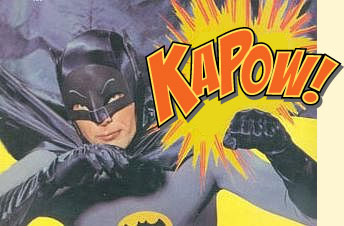
The Batman television series, which debuted in 1966, is now remembered as the worst thing to ever have happened to the franchise. But it was immensely popular in its time, and this drastically impacted the image of the character in comic books too. Adam West's Batman was an unfit comic vigilante in an embarrassingly tight costume, who slid down a pole a la firemen to reach the Batcave, and the screen flashed "KAPOW" when he punched criminals. 


The stuff of Batman fans' nightmares,
Adam West as Batman in the 1966 TV series


He was a sad sad parody of his dark brooding former self. Robin as his sidekick was even more of a joke, figuratively as well as literally, and most of his sentences started with "Holy" and ended with "Batman". Although initially successful, as most parodies are, the show as well the comics eventually lost its audience. As the comic editor Julius Schwartz himself said, "When the television show was a success, I was asked to be campy, and of course when the show faded, so did the comic books."

By the late 1960s, a conscious effort to distance the character from this comic image had started through the collaboration of writer Dennis O'Neil and artist Neal Adams. Batman once again found himself in grim surroundings, investigating dark, dirty cases, and sick criminal minds. Some of the stories had a gothic feel to them and nearly bordered on horror, as the readers were made to realize once again that the bat costume is not supposed to be funny. However, the popularity of the franchise continued to drop throughout the 1970s and early 1980s, until some lifelong fans and graphic novel veterans decided to do some damage repair.


The resurgence of the anti-hero

Death of the Joker in The Dark Knight Returns (1986)
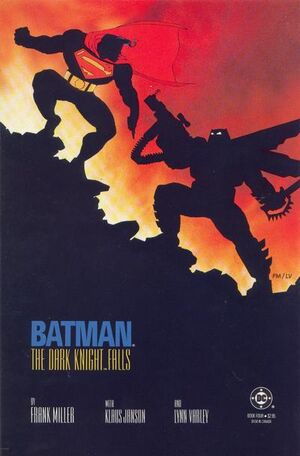
Frank Miller's 1986 limited series Batman: The Dark Knight Returns, which tells the story of a 50-year-old Batman coming out of retirement in a possible future, reinvigorated the character. DKR, as it is affectionately referred to by fans, was not only critically acclaimed, but was a major financial success too. Although the importance of this may be downplayed by "true" fans, it is noteworthy that the Batman of the 70s was critically acclaimed too, but was still on the verge of being cancelled due to lack of popularity. Miller pretty much laid, or maybe re-laid, the ground for Batman and everything related to him as we see it today. The scary Joker, the hopelessly corrupt Gotham city police force, Bruce Wayne's recurring nightmares about his parents' murder, and of course, to top it all he added a dash of Batman vs. Superman to the mix. The artwork was also markedly different, bordering on avant-garde, and in a macabre way. Miller's Batman was morally ambiguous, in the sense that although he had very high moral standards which he chose to impose on the society that just refused to get in order, neither his opinions nor his methods always fell within the moral bounds prescribed by society. He was, in many ways, an anti-hero, who despised the fact that Superman had "sold out" to the government and derided his righteous attitude as boy scout-like. The concept of Batman and Joker being each other's raison d'etre also gained mainstream popularity following this series. Readers lapped it up.
Batman's confrontation with Superman was one of the chief attractions of Dark Knight Returns (1986)
The epic face-off that was
the highlight of The Dark Knight Falls
During the same period, DC was in the process of rebooting the histories of its major characters through the Crisis on Infinite Earths series. Batman's origins were re-written by Frank Miller in the Year One storyline, which also attempted to beef up the character of Jim Gordon.

Alan Moore continued this dark trend with 1988's 48-page one-shot Batman: The Killing Joke, in which the Joker, attempting to drive Commissioner Gordon insane, cripples Gordon's daughter Barbara (Batgirl), and then kidnaps and tortures the commissioner, physically and psychologically. Moore continued the theme of Batman being the reason for Joker's existence and vice-versa. In fact, the last few panels, with the two arch enemies laughing like madmen over a silly joke (the Killing Joke) exemplifies just how beautifully twisted this superhero really is.


Following this, the character has essentially stuck to its image, despite minor variations. The 1988 release A Death in the Family and 1993's Knightfall are good examples. Although the artwork was not as unconventional as DKR, the themes remained morbid. After sustained popularity throughout the 1990s, Jeph Loeb's 2003 Batman: Hush series marked the return of Batman at the top.


Movies

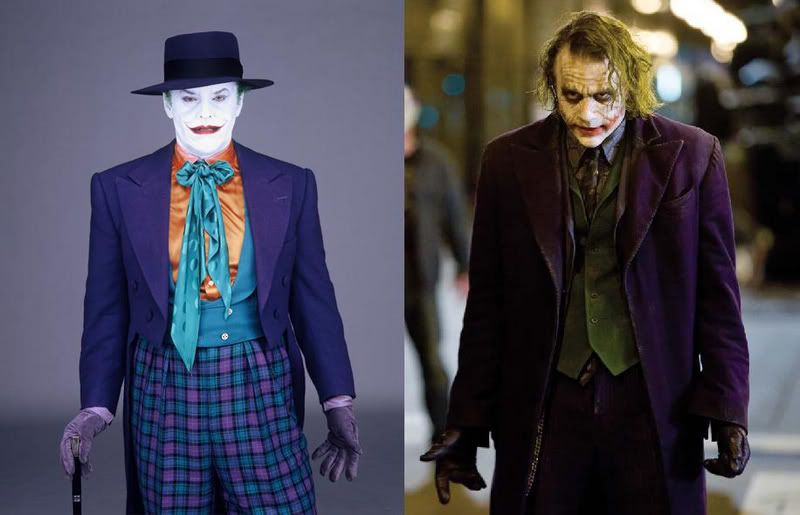
The Two Jokers: Jack Nicholson in Batman (1989) and Heath Ledger in The Dark Knight (2008)
Jack Nicholson (Batman, 1989) and
Heath Ledger (The Dark Knight, 2008) as
Joker, the iconic Batman villain
The portrayal of Batman and other related characters in other media has followed more or less the same pattern as in the comics, but over a much shorter period of time. Tim Burton's two Batman movies were dark and violent in a depressing way, much like the early Batman comics as well as DKR and The Killing Joke, which served as his primary inspirations. Michael Keaton made a sufficiently dark Batman, while Jack Nicholson was undoubtedly the best Joker until Heath Ledger came along. However, Batman Returns, the second movie in the series, turned out to be too morbid for the mainstream audience, and the baton passed on to Joel Schumacher to revive popular interest. His portrayal of the franchise took it back to its 60s campy feel, but with bigger budgets and elaborate special effects. While Batman Forever (1995) was a huge commercial success, and Val Kilmer was not too much of a compromise as Batman, try pitting Tommy Lee Jones' part comic act as Harvey Dent/Two-Face against the character as depicted in DKR or the recent version portrayed by Aaron Eckhart in The Dark Knight (2008). In both the latter cases, the character of Harvey Dent is seriously scarred, not only physically, but emotionally as well, and Miller makes it clear that even if his face is fixed, the emotional scars can't be remedied by plastic surgery. Schumacher's next offering Batman & Robin (1997) was not just a bad Batman movie, but a really bad movie from every aspect. George Clooney, in his nippled costume, was a pathetic caricature of the dark knight, and the others are not even worth mention.


Then, following a 8-year hiatus, Christopher Nolan re-launched the character the way it was meant to be.

The rest, as they don't say, is the present.

Images: Photo Bucket, Studio Daily,Wikipedia, DC Wikia

Thursday, September 11, 2008

Us and Them

(That this post has been published on the anniversary of 9/11 doesn't really have anything to do with anything)

"Take all your overgrown infants away somewhere,

and build them a home
a little place of their own
The Fletcher Memorial Home for incurable tyrants and kings"
- The Fletcher Memorial Home by Pink Floyd (don't say "not again!" yet, the post is not about them, or the interpretation of their song lyrics)


The overgrown infants referred so affectionately to by Roger Waters in this lesser known song from one of the band's least known albums, are of course Messrs. Hitler, Mussolini, Stalin, Brezhnev, Khrushchev, Nixon, Reagan, Thatcher, and their ilk. I really like the incurable tyrants expression, which I believe fits the bill quite perfectly for someone like Stalin, who milked the seemingly idealistic theory of communism in the worst way imaginable. Nixon, despite his staunch anti-communist views couldn't prevent himself from being cast in the same mould as his arch-enemies. Unlike Stalin, he didn't slaughter his opponents for the sake of one-upmanship. He chose to do it in his own unromantic and weasly way - by planting bugs in their workplace. If an attempt is made to imagine a common forum where all the legendary figures mentioned above can exchange high-fives (or maybe throw sheep at each other), it'd have to be a community with a cool title like "Lust for power" or "My chair and why I can't live without it".

The song was written during the early 80s, at the time Maggie decided that the choice between avoiding a costly, needless war and retaining power ain't no choice at all. Even though hippie counter-culture had died out long ago, the musicians of yore were not able to let go of their protesting ways. To their credit, the politicians never stopped giving them reasons. Cut to the early 21st century, and to pseudo-hippies sitting around in Indian engineering colleges. Add a little 9/11-and-its-aftermath theme to the mix, and you have on your hands a spicy discussion between sworn capitalism fans and even more sworn idealists-who-don't-know-yet-that-they-are-actually-talking-like-communists. Needless to say, the geopolitical frenzy of profit-driven wars hasn't changed the least bit with the inevitable dissolution of the Soviet Union. The US doesn't have anybody left to fight with, so they're just doing it alone in exotic middle-eastern locations. That these locations happen to have huge deposits of some hydrocarbons that fuel every non-living thing that moves, is probably just Jo-incidence with a C. Protests are no longer cool like the good old days, when agitation was symbolized by Mary Jane and an enduring image of Bob Marley. But hey, people are still pissed off at the overgrown infant-like ways of Bush, Cheney, Medvedev & Co.

It is also very interesting (for me, at least) that a large number of authoritarian rulers have communist inclinations. This is because I believe that communism at its heart is a philosophy inspired by the most idealistic notions of an equal and just world. "From each according to his ability, to each according to his need" appears a very noble concept, at least prima facie. However, I guess what I've learned is that the world was never supposed to be an ideal place, and it can't be forced to be that way. Which is why communism doesn't work in practice, and precisely why religion does. It is impossible to make humans work against their will, unless you scare them with the power of an unknown all-powerful force. Communism discounts God, and hence appears more cruel when implemented. Because cruelty is only permissible in the name of the father, the son, and the holy ghost.

My tone may have revealed my inclinations. Yes, I have invariably been on the communist-leaning side of the debate. Probably it's because of my obsession with classic rock, or maybe it's the other way round. Whatever, I used to be throughly sold out to the belief that people like Dubya need to like 'grow up dude' and stop 'fucking everybody's shit up'! Shrewd and cunning were words I never used without negative connotations. Politics as a motive in itself was something I never understood. Then, on the insistence of the biggest proponent of capitalism I've ever come across in real life, aka dassa, I watched the documentary Commanding Heights - aka "A shameless ode to Capitalism", aka "Capitalism ka munh mein kyun nahi le lete ho?"

The self-proclaimed "unbiased" look at the trends in world markets during the 20th century is actually quite intriguing, despite its obvious bias. It starts off pretending to be an innocent story of the transition of world markets from the free trading phase to Keynesian regulated economies following WWII, and back to free markets sometime during the early 80s. It ends up a we-told-you-we-were-right kind of chest-thumping proclamation by the capitalists. My own reaction to the movie has been kind of like the world markets. At first, I was impressed immensely, thanks in no small part to the sheer art of movie-making. It is extremely well-paced for a documentary, does not support any single viewpoint in any overt way, and is peppered with sufficient masala for an economics illiterate and political imbecile like me to not be completely lost. Then, after a whole lot of wiki-ing and googling, I became thoroughly convinced that it's a desperate capitalist ploy, presumably to support US's aggressive expansionist behavior. Now that I think about it, my view is more or less ambivalent. Have I grown up?

It was this question that actually drove me to write this post. Who exactly is a grown up? What does it mean to grow up? One particuarly interesting portion of Commanding Heights is the UK episode. In the early 80s, Thatcher was apparently trying her best to break the shackles and free the UK economy from unnecessary regulatory burdens and government control. However, the short-term effect of any such action is a state of chaos, speaking very broadly. In very simple terms, when price control is lifted, the immediate impact will be a rise in prices, sometimes a drastic one. However, the free market theory, propounded by Von-Hayek, argues that free markets tend to be the most stable in the long term. The bottom line is that Thatcher was nearing the end of her term at the time she proposed economic reforms, and would not have been in power to see those through. She needed to retain power to implement her policies successfully. The Falklands War gave her a chance to do that. Inasmuch as can be determined with absolute certainty, the war was not about the British economy in any real way. However, the improbable win brought with it a euphoria drenched in nationalism and gave Thatcher the much-needed breathing space, and allowed her to usher in globalization and a free economy.

Now, Mr. Waters wrote an entire album devoted to the Falklands War, the first track of which begins with the heart-rending plea
"Should we shout? Should we scream?
What happened to the post-war dream?
Oh Maggie, Maggie what have we done?"

Of course, this wasn't the first time Waters had been disgusted by a needless war, nor was it the last. The point here is, the accusation of immaturity that each group directs towards the other.
I really, really like the lyrics of A Fletcher Memorial Home. Dictators , autocrats, and in general rulers with an iron fist are very difficult people to understand. While some like Hitler and Stalin generate almost unanimous hatred for their murderous ways, others like Thatcher have a much more divided opinion about them. Almost invariably, they say that they are driven by some alleged greater good whch requires a few sacrifices - "the whole you can't make an omelette without breaking a few eggs" routine. The idealists find this particular political philosophy unimaginably inhuman. I can say because I used to be one. My feeling was that it is not okay for even one person to suffer needlessly for any purported greater good that may well be a political tactic designed to satisfy one person's lust for power. I was all

"Us and them, and after all we're only ordianry men
.
Me and you, God only knows it's not what we would choose to do."

The rebuke I often was at the receiving end of went something like this.

"It's not an ideal world."
"What you're saying seems right in theory, but it's impossible to implement in practice."
"This is your inexperience talking. You haven't seen the real world."
"You're just a starry-eyed 20-something with romantic ideas of an ideal world. Get real."
"Grow up!"

It used to bug me no end. Even now, I am fairly certain that no matter what greater interest lies at their hearts, iron-fisted rulers are a selfish breed. There's a childishness about their way of not wanting to let go of their power - the fairly simplistic analogy of a child not wanting to give up his/her toy is pretty apparent here. Their obsession is disturbingly amusing to me, and I'm pretty convinced that if this obsession is in fact real, then it is a sign of genuine mental illness - hence back to the overgrown infant theme.They are incapable of growing up!

On the other hand, let's take a look at Roger Waters himself. His father died in action during the WWII. Following this, every incident in his life became an instrument of trauma, including his mother, his teachers, his wife (All this is conjecture by the way. Very, very likely, but not necessarily true). After he took over the band, he wrote numerous songs about war, and the one major war Britain fought during his lifetime (the Falklands War) troubled him enough to write an entire album. In a way, he was never able to rid himself of his childhood demons, and got angry or scared whenever those were woken up in much the same way as an overgrown infant would.
Ironically, his continuous whining against the childish behaviour of politicians itself seemed to gather a childish hue as time passed.

But overall, my stance now is of a passive observer. There are very few things that truly appall me now. Whether it be a needless war or an needless agitation, there is a sense of wonder in my reaction as I try to figure out the motivation of the people driving those. Politics as an art is something that I still don't approve of, but I'm most definitely intrigued by it. Conspiracy theorists and activists have started to appear as self-obsessed as the people they're up in arms against. I watch the machinations of politics and protests with equal abandon. Well, maybe not really equal. I still do have idealistic traits - which leads me to wonder who really is grown up? Us or them?

Sunday, June 29, 2008

'69

There was a time-bending game that once played me
And I learned that amusement ain't the same as ecstasy
When I think about it now, I can barely define
The fundamentals of '69

There's a thin,white veil that protects my being
A whiff of joy is a wonderful thing
I could captivate every moment in time
Riding on the waves of '69

When you can see your head brought in upon a platter
You're not a prophet, though it may seem like a great matter
A drag in time makes you want another nine
When you get the taste of '69